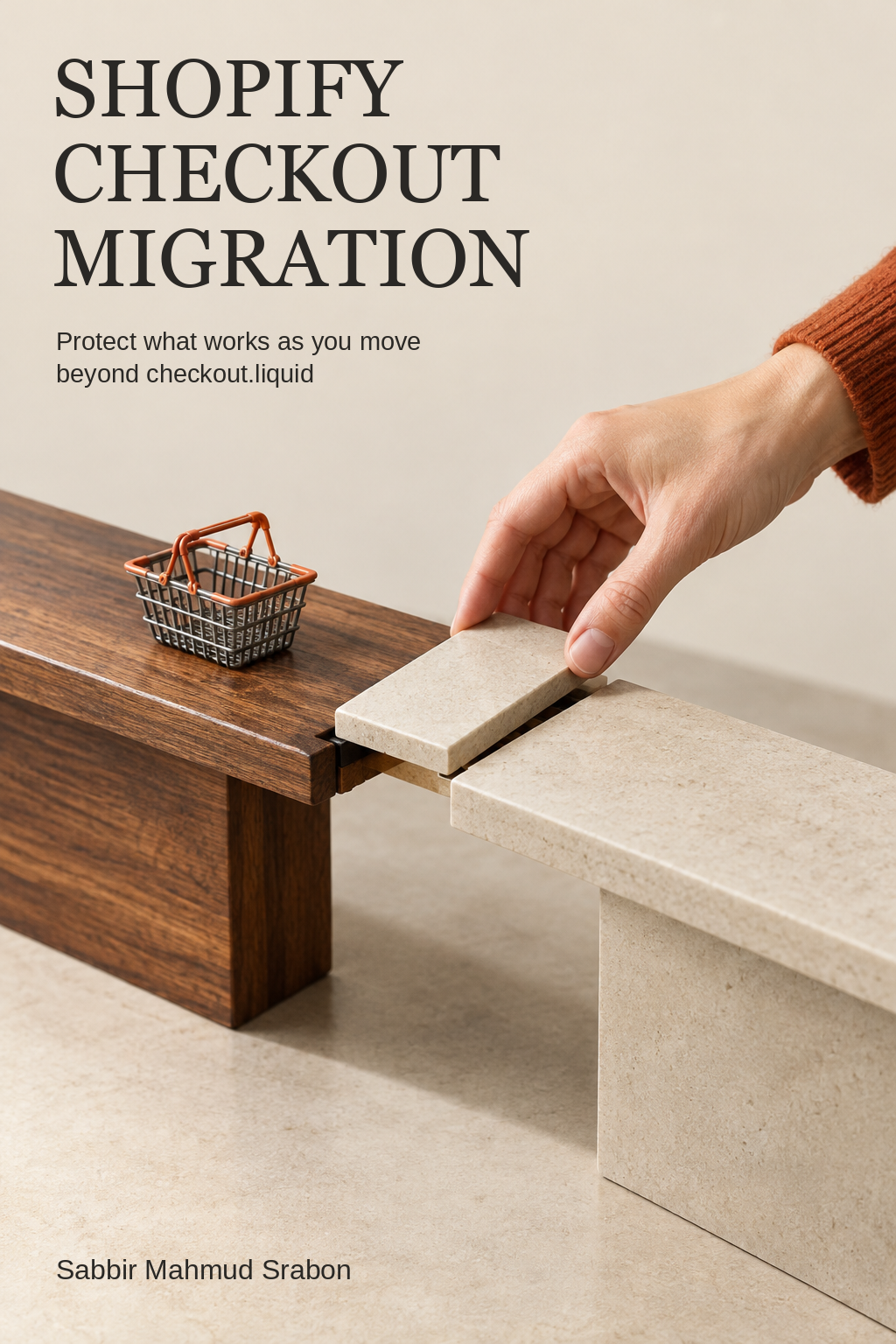

Shop Pay and Installments: Smoothing the Friction in Shop App Checkout
222 prompts22 categoriesBuilt for Shopify merchants
Private checkout program · Interactive book + Shop Pay Checkout Command Center
Workspace for this book: ● Available What does a workspace mean?
A workspace is your private place to solve this problem in your own business. You do not just read about the problem. You work through it, with your own facts:
- Enter your details once (checkout data, payment options, disputes and customer messages).
- Pick the stage you are in.
- Get every prompt personalised to you and copy it in one click.
- Keep your records together in one place.
It opens in your TPP account right after purchase, in the language you choose.
Payment options help conversion, yet they can also create confusion, disputes and support questions after the purchase. Knowing their real effect needs more than a glance at the dashboard.
Not merely a book to read: a working system for finding where Shop Pay and installments confuse your shoppers, and deciding what to do about it.
- Walk your own mobile checkout and find where first-time shoppers pause.
- Fill in your own store facts once and reuse them across every prompt.
- Copy the personalized prompt in one click, or request the complete PDF by email.
Available in multiple languagesSee in which languages this book is available
You may get the book in any language you prefer, including your mother tongue.
 Abkhazian (Abkhaz)
 Acehnese
 Acoli (Acholi)
 Afrikaans
 Akan (Twi)alz (Alur)
 አማርኛ (Amharic)
 العربية (Arabic)
 অসমীয়া (Assamese)Awadhi
 Aymara
 azərbaycan (Azerbaijani)
 башҡорт (Bashkir)BalineseBatak Toba
 беларуская (Belarusian)
 Ichibemba (Bemba)Betawi
 български (Bulgarian)भोजपुरी (Bhojpuri)
 Bikol
 bamanakan (Bambara)
 বাংলা (Bengali)
 brezhoneg (Breton)
 bosanski (Bosnian)bts (Batak Simalungun)btx (Batak Karo)буряад (Buryat)
 català (Catalan)CebuanoRukiga (Kiga)Mari (Meadow Mari)
 کوردیی ناوەندی (Kurdish (Sorani))
 cnh (Hakha Chin)Corsican
 Crimean Tatar
 Seselwa Creole French (Seychellois Creole)
 čeština (Czech)чӑваш чӗлхи (Chuvash)
 Cymraeg (Welsh)
 dansk (Danish)
 Deutsch (German)
 Dinkaडोगरी (Dogri)dov (Dombe)
 Divehi (Dhivehi)
 རྫོང་ཁ (Dzongkha)
 eʋegbe (Ewe)
 Ελληνικά (Greek)
 English
 Esperantoespañol (Spanish)
 eesti (Estonian)euskara (Basque)
 فارسی (Persian)
 Pulaar (Fulani)
 suomi (Finnish)Filipino
 Fijianfrançais (French)
 français (Canada) (French (Canada))
 Frysk (Frisian)
 Gaeilge (Irish)Gã (Ga)Gàidhlig (Scots Gaelic)galego (Galician)
 Guaraniकोंकणी (Konkani)ગુજરાતી (Gujarati)
 HausaʻŌlelo Hawaiʻi (Hawaiian)
 עברית (Hebrew)हिन्दी (Hindi)HiligaynonHmong
 hrvatski (Croatian)hrx (Hunsrik)
 Haitian Creole
 magyar (Hungarian)
 հայերեն (Armenian)Indonesia (Indonesian)IgboIloko (Ilocano)
 íslenska (Icelandic)
 italiano (Italian)עברית (Hebrew)
 日本語 (Japanese)Jawa (Javanese)Jawa (Javanese)ქართული (Georgian)
 қазақ тілі (Kazakh)
 ខ្មែរ (Khmer)ಕನ್ನಡ (Kannada)
 한국어 (Korean)
 Krio
 ktu (Kituba)
 kurdî (kurmancî) (Kurdish (Kurmanji))
 кыргызча (Kyrgyz)
 Latin
 Lëtzebuergesch (Luxembourgish)Luganda
 Limburgishligure (Ligurian)Lombardlingála (Lingala)
 ລາວ (Lao)
 lietuvių (Lithuanian)
 Latgalian
 Dholuo (Luo)Mizolatviešu (Latvian)मैथिली (Maithili)Makasar (Makassar)
 Malagasy
 Māori (Maori)Minangkabau (Minang)
 македонски (Macedonian)മലയാളം (Malayalam)
 монгол (Mongolian)মৈতৈলোন্ (মীতৈ ময়েক) (Meiteilon (Manipuri))मराठी (Marathi)
 Melayu (Malay)Melayu (Arab) (Malay (Jawi))
 Malti (Maltese)
 မြန်မာ (Myanmar (Burmese))
 नेपाली (Nepali)Newari (Nepalbhasa (Newari))Nederlands (Dutch)
 norsk (Norwegian)South Ndebele (Ndebele (South))Sesotho sa Leboa (Sepedi)Thok Nath (Nuer)
 Nyanja (Chichewa)occitanOromoo (Oromo)ଓଡ଼ିଆ (Odia (Oriya))ਪੰਜਾਬੀ (Punjabi (Gurmukhi))
 پنجابی (عربی) (Punjabi (Shahmukhi))PangasinanPampanga (Kapampangan)
 Papiamento
 polski (Polish)
 پښتو (Pashto)
 português (Portuguese (Brazil))português (Portugal) (Portuguese (Portugal))
 Runasimi (Quechua)
 Ikirundi (Rundi)
 română (Romanian)Romany (Romani)русский (Russian)
 Ikinyarwanda (Kinyarwanda)संस्कृत भाषा (Sanskrit)sicilianu (Sicilian)سنڌي (Sindhi)
 Sängö (Sango)တႆး (Shan)
 සිංහල (Sinhala)
 slovenčina (Slovak)
 slovenščina (Slovenian)
 Samoan
 chiShona (Shona)
 Soomaali (Somali)
 shqip (Albanian)
 српски (Serbian)
 SwatiSesothoBasa Sunda (Sundanese)
 svenska (Swedish)
 Kiswahili (Swahili)ślōnski (Silesian)தமிழ் (Tamil)తెలుగు (Telugu)
 Tetum
 тоҷикӣ (Tajik)
 ไทย (Thai)
 ትግርኛ (Tigrinya)
 türkmen dili (Turkmen)Filipino
 Setswana (Tswana)Türkçe (Turkish)Tsongaтатар (Tatar)ئۇيغۇرچە (Uyghur)українська (Ukrainian)اردو (Urdu)
 o‘zbek (Uzbek)
 Tiếng Việt (Vietnamese)IsiXhosa (Xhosa)ייִדיש (Yiddish)Èdè Yorùbá (Yoruba)
 yua (Yucatec Maya)
 粵語 (Cantonese)中文 (Chinese (Simplified))中文(中国) (Chinese (Simplified))
 中文(台灣) (Chinese (Traditional))isiZulu (Zulu)
No matching language found.
Synopsis
A checkout that feels confusing to a first-time shopper quietly costs orders and trust, and it rarely says why. Many merchants guess, or change the wrong thing.
This playbook turns that problem into a structured program. Inside its Shop Pay Checkout Command Center, merchants enter their store details once, choose the stage they are in, and personalize prompts to their own checkout, order values and policies.
See more
Your purchase includes both the reusable interactive workspace and the complete PDF book, so you can work online or keep a copy.
The 22 categories run from mobile checkout walkthroughs and revenue analysis to installments rules, returns, support scripts, disputes, fraud patterns and rollouts. The book is educational and does not guarantee any result.
Free, 1 minute
Are payment options helping or confusing? Take the 7-point Shopify check
Tick what is true for you today. Nothing is saved or sent.
Tick the statements that apply to you.
Try two complete prompts from the book
These are not teasers. Each one is a full, working prompt, word for word from the book. Copy it, fill in your own details and use it in ChatGPT, Claude, Gemini or any AI tool. Inside the book you get 220 more, with your own details filled in for you.
Try it with your own details: click any highlighted field and type. The prompt updates as you type, and “Copy this prompt” copies your version. Nothing is saved or sent anywhere.
Category 1: Diagnosing Where Shop Pay's Mobile UX Causes Real Checkout ConfusionPrompt 1 of 10: Walking the Full Mobile Checkout as a First-Time Customer+
I run a Shopify store with Shop Pay enabled and I want to personally walk through my own mobile checkout the way a first-time customer would, so I can catch confusion my team has stopped noticing. Act as a senior conversion-rate optimization consultant who specializes in mobile checkout audits for Shopify merchants using Shop Pay.
Here's what you can work with:
- my store's checkout URL and theme details: store checkout setup
- the specific mobile devices and browsers I can test with: test devices available
- whether Shop Pay Installments is enabled at checkout: installments enabled status
- any checkout customizations I've added beyond Shopify defaults: custom checkout elements
- my current mobile checkout conversion rate for context: current mobile conversion rate
Work through this step by step:
1. build a realistic first-time-customer script covering product selection through order confirmation on test devices available
2. flag every screen where custom checkout elements could plausibly compete with or obscure the Shop Pay button
3. note where installments enabled status changes what information appears and whether it's introduced clearly
4. identify moments where a first-timer would need to pause, scroll back, or guess what happens next
5. compare what you observe against current mobile conversion rate to flag whether any step looks disproportionately risky
6. rank the observed friction moments by how severe the confusion would feel to someone with zero Shop Pay familiarity
Give me your answer as a step-by-step walkthrough log (Screen | What I Saw | Friction Risk | Why) covering the entire flow, followed by a short list of the three most concerning moments.
Before you give me your answer, check yourself: did you actually simulate a true first-time customer's perspective on test devices available rather than an experienced user's assumptions, and does every flagged moment tie back to something concrete in custom checkout elements or installments enabled status? Keep every answer specific to Shopify and do not borrow rules, screens or fees from other platforms.
Complete prompt, exactly as in the book. Highlighted parts are the details you fill in. The copy button gives you the same prompt with [brackets] to fill in with your own details.
Category 4: Diagnosing Cart Abandonment Linked to Shop Pay ConfusionPrompt 1 of 10: Comparing Abandonment Rates for Sessions That Engaged With Shop Pay vs. Didn't+
I run a Shopify store and I want to compare cart abandonment rates between sessions that engaged with Shop Pay at some point and sessions that never touched it, to see if engagement itself correlates with abandonment. Act as a Shopify checkout behavior analyst who specializes in comparing abandonment patterns across payment-method engagement.
Here's what you can work with:
- session-level data showing whether Shop Pay was engaged with and whether the cart was abandoned: session engagement and abandonment data
- the point in the session where Shop Pay engagement typically occurs: shop pay engagement point
- overall abandonment rate for comparison context: overall abandonment rate baseline
- whether engaged sessions differ in traffic source or intent from non-engaged sessions: engaged vs nonengaged traffic differences
- any recent change to how or where Shop Pay is presented: recent shop pay presentation changes
Work through this step by step:
1. calculate abandonment rate separately for engaged versus non-engaged sessions in session engagement and abandonment data
2. compare both rates against overall abandonment rate baseline to see which group deviates and by how much
3. check engaged vs nonengaged traffic differences to rule out the gap being explained by different customer intent rather than Shop Pay itself
4. note where shop pay engagement point falls in the session relative to when abandonment actually happens
5. factor in recent shop pay presentation changes if the pattern shifted recently
6. state whether engagement itself appears to correlate with higher abandonment or whether the two groups simply differ in intent
Give me your answer as a comparison table (Group | Abandonment Rate | vs. Baseline | Plausible Explanation) plus a clear verdict on whether Shop Pay engagement itself is implicated.
Before you give me your answer, check yourself: did you rule out engaged vs nonengaged traffic differences as the real explanation before blaming Shop Pay, and does your verdict account for shop pay engagement point timing? Keep every answer specific to Shopify and do not borrow rules, screens or fees from other platforms.
Complete prompt, exactly as in the book. Highlighted parts are the details you fill in. The copy button gives you the same prompt with [brackets] to fill in with your own details.
Review every answer against your own records and the current Shopify terms and policies.
Behind the book
How this book was made
Two teams work behind every Prompt Powerhouse book. Sabbir Mahmud Srabon owns and publishes it.

Words from the problem research team
Convenience at checkout has a cost too
Payment features change how customers behave and what they expect afterward. Measuring incremental effect and clearing up communication keeps the benefit and removes the friction.
We look at where merchants get stuck and turn it into 22 clear stages, from “Diagnosing Where Shop Pay's Mobile UX Causes Real Checkout Confusion” all the way to “Building a Post-Purchase Communication Plan for Installment Customers”.
Seen this problem in your own business, or know something we missed? Write to our problem research team: [email protected]

Words from the author team of this book
Prompts that measure it and clear the confusion
Each of the 222 prompts has blanks for your own information, which keeps every answer tied to your business, your records and your numbers.
We only claim what we can stand behind. This is educational, independent of Shopify, and makes no promise of results. It gives you a plan to follow and check.
Questions about the prompts in this book, or an idea to make them better? Write to our author team: [email protected]
222ready-to-use prompts
22categories, one for each stage of the problem
1088fill-in details that personalise every prompt to you
10+prompts in every category
Every category covers one stage of the problem, from “Diagnosing Where Shop Pay's Mobile UX Causes Real Checkout Confusion” to “Building a Post-Purchase Communication Plan for Installment Customers”.
What makes it different
More than an eBook. Your private checkout program.
Move from "customers say checkout is confusing" to a clear, documented routine.
1Find the frictionWalk the checkout, read the analytics and test what Shop Pay adds.
2Add your storeReplace guided variables with your own details.
3Personalize and copyTurn the framework into a ready-to-use prompt in one click.
4Work through every stageDiagnose, decide, align, support, respond and sustain, all in one place.
Both experiences are included: use the live Shop Pay Checkout Command Center to complete the work, and request the traditional digital PDF book through email whenever you want it.
Questions before you buy
Is this just a list of ChatGPT prompts?
The prompts work in any AI tool you already use. What the book adds is the structure: they are organised into 22 stages of the problem, and the workspace holds your details so you enter them once and they fill every prompt (1088 variables). You also keep your records in the same place.
Which AI tools does it work with?
ChatGPT, Claude, Gemini and local models. Any tool that accepts text works.
Is it a subscription?
No. The complete program is a one-time purchase with lifetime eligible workspace updates.
Why do I need an account?
Your account creates your private workspace and uses your name and username to personalise the book for you. It takes about 20 seconds, then you pay securely with Paddle.
What if it turns out not to fit me?
Yes, we’ve got you. If it is the very first book you purchase on TPP and it does not help your business, email us at [email protected] and we’ll refund you in full.
Will it fix my problem?
It cannot promise results. It gives you a clear, step-by-step way to find the cause, gather the evidence and take action. It is educational and not affiliated with Shopify.
Can I get the book in my language and as a PDF?
Yes. The workspace is available in many languages (see the language picker near the title), and you can request the complete book as a PDF by email whenever you like.
Become a Founding Entrepreneur
This book is new. We are inviting a small group of entrepreneurs to put it to work in their own business and tell us honestly what happened. Their words will appear here, with their permission, and only if they are real.
Want to be one of them? Tell us about your Shopify business.
Apply as a Founding EntrepreneurAbout this book
Book details
InteractiveFormatShopifyPlatformInstantAccess
- Author
- Sabbir Mahmud Srabon
- Publisher
- The Prompt Powerhouse
- PSBN
- PSBN-32058-1123-5186
- Workspace
- Complete private Shop Pay Checkout Command Center included
- Delivery
- Interactive account access plus PDF by email on request
- Purchase
- One-time complete-program ownership
Languages
You may get the book in any language you prefer, including your mother tongue.
See the full language availability near the book titleWhat is a Magical Workspace?
1
Choose your situationOpen the stage closest to where you are: diagnose, decide, align, support, respond or sustain.
2
Add your store detailsEnter your checkout setup, order values and policies once; they fill every prompt.
3
Review and copyCheck the personalized prompt, then take it to your AI tool in one click.
4
Keep your recordsSave decisions, dates and reasons as you go.
Explore this book before purchasing
The 22 categories inside the playbook
Diagnosing Where Shop Pay's Mobile UX Causes Real Checkout ConfusionMeasuring Shop Pay's True Incremental Revenue vs. CannibalizationAuditing Checkout Analytics to Separate Genuine Shop Pay Lift From UX DragDiagnosing Cart Abandonment Linked to Shop Pay ConfusionAuditing Checkout Speed Impact From Shop Pay EnablementComparing Shop Pay Installments Against Other BNPL Options for a StoreDeciding Whether to Keep, Limit, or Disable Installments by Order ValueDeciding Installments Eligibility Rules by Product CategoryAuditing Shop App Integration for Order-Status ConsistencyBuilding a Returns Policy That Accounts for Installment PaymentsBuilding Merchandising Strategy Around Shop App Discovery FeaturesExplaining Shop Pay Clearly on Product and Checkout PagesBuilding a Customer FAQ for Installments Terms and FeesTraining Support Staff on Shop Pay-Specific Customer QuestionsTraining Staff on Explaining Installments During Live Chat SupportLocalizing Shop Pay Messaging for New International MarketsAuditing Shop App Reviews and Ratings Tied to a Specific StoreHandling an Installments Dispute Within Affirm's 15-Day WindowHandling a Customer Dispute Over Misunderstood Installment TermsHandling Fraud Risk Patterns Specific to Installment OrdersPlanning a Rollout of Shop Pay Installments to a New MarketBuilding a Post-Purchase Communication Plan for Installment Customers
How to read and use
Purchase the complete book. Open the workspace from your TPP account, choose a language and problem, personalize the marked variables, then copy the prompt or request delivery to your email.
Customer reviews
Ready to catch what quietly slips?
Get the complete private program, interactive book, command center and optional emailed PDF.
$1516Buy Now
Research this book before purchasing
The sales page stays focused. These connected guides explain how to walk your own checkout, how installments appear to customers, and how the Shop Pay Checkout Command Center turns the book into a usable program.
Complete book overviewCoverage, formats, workspace and related resources.Walk your mobile checkout like a first-time customerFind where shoppers pause and write it down.Checkout friction fix workflowAn ordered route from symptom to measured action.Shop Pay workspace personalizationEnter your store details once and reuse them.How Shop Pay Installments appear to customersWhat decides whether the option shows.Where Shop Pay confuses first-time buyersFour moments to test and how to weigh fixes.