What this book actually is
Short answer: tariffs on goods from China, and from other origins, are set by the importing country's government, so a change can raise your cost per unit whatever price a supplier quotes on Alibaba.com. This book gives you a repeatable process for rechecking your numbers whenever that happens.
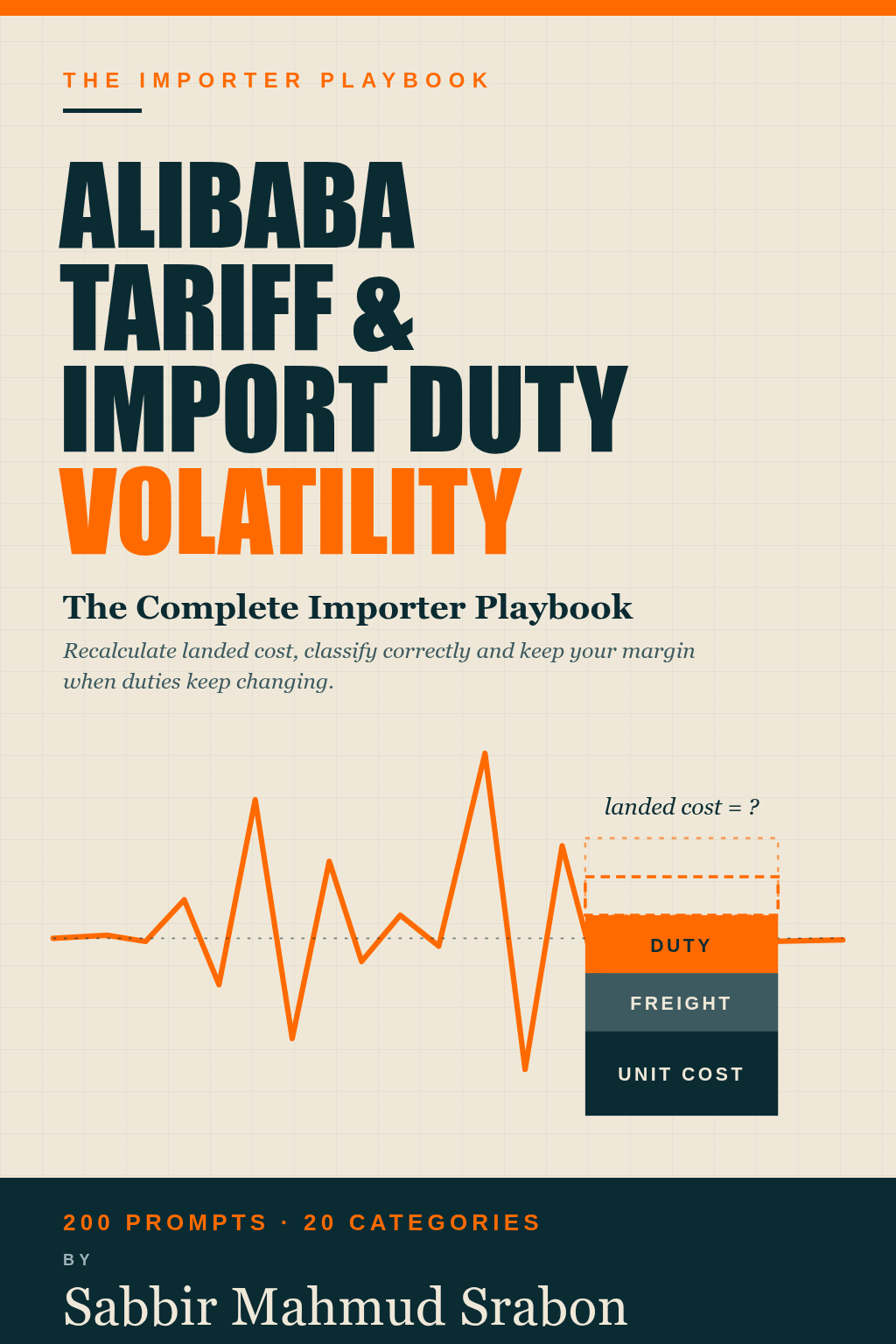
Import duties are set by governments, not by Alibaba.com, and they can change with little notice. A landed-cost number that was right when you placed your last order can be wrong by the time you place the next one. This book is an interactive problem-solving program, presented as a complete digital book, for that exact situation. It does not tell you what any duty rate is today. It gives you 200 structured prompts that make an AI assistant ask for your real inputs, walk through the reasoning step by step and hand back a checklist, a calculation, a draft message or a decision you can verify.
Its private Tariff Command Center lets you enter your product and shipment facts once and reuse them across every prompt. You can also request the full digital PDF by email. The book was prepared by a team of expert prompt engineers, problem researchers and editors, and is published by The Prompt Powerhouse under the authorship and ownership of Sabbir Mahmud Srabon. Read more about the author on the author page.
Who it is for
It is written for small and mid-sized importers, private-label sellers and resellers who source from suppliers on Alibaba.com and sell onward, whether through their own store, a marketplace or wholesale accounts. If a duty change would force you to recalculate prices, renegotiate with a supplier or rethink where you source, the prompts are built for you. It is not written for customs brokers or trade attorneys, and it does not replace them; several prompts help you work with one more effectively.
Platform facts, such as Trade Assurance terms, payment options and inspection services, are described only as published by Alibaba.com, which may change. Duty facts are always pointed back to the official customs and tariff authorities, with the date you checked them.
Terms used on this site. MOQ (minimum order quantity) is the smallest order a supplier will accept. An RFQ (request for quotation) is a formal request asking suppliers to price a specific order. OEM (original equipment manufacturer) means a factory makes a product to your specification or under your brand. Incoterms are standard trade terms such as EXW, FOB and CIF that divide cost and risk between buyer and seller. HTS is the Harmonized Tariff Schedule, the code system customs authorities use to classify goods for duty.
Import duty changes are hardest on a small business: margins are thin, there is rarely a compliance team, and a landed cost calculator or spreadsheet built months ago keeps giving confident but outdated answers. The prompts are built to catch exactly that.
The problem map: 20 categories in five stages
The categories run in the order most importers need them. The category names are public; the prompts themselves are only available inside the book.
- Measure: Calculating True Landed Cost Including Current Section 301/IEEPA Duties; Classifying a Product's Correct HTS Code to Avoid Duty Overpayment; Understanding De Minimis Rule Changes and Their Impact on Small Orders; Requesting a Binding Ruling for Ambiguous HTS Classification; Tariff Considerations Specific to Electronics/Regulated Categories.
- Monitor: Tracking Tariff-List Updates That Could Reclassify a Product Mid-Cycle; Deciding Order Timing Around Announced Tariff Effective Dates; Monitoring Trade-Policy News Sources for Early Tariff Warnings.
- Source: Re-Negotiating Supplier Pricing to Absorb Part of a New Tariff; Evaluating Near-Shoring/Alternate-Country Suppliers as a Tariff Hedge; Diversifying Sourcing Across Multiple Countries to Reduce Tariff Exposure; Working With a Customs Broker to Manage Ongoing Tariff Risk.
- Price: Building Tariff Contingency Into New-Product Launch Financial Models; Passing Through vs. Absorbing Tariff Costs in Retail Pricing; Modeling Multiple Tariff Scenarios Before Committing to a Large Order; Tariff Impact on Private-Label Margin Structures Specifically; Communicating Tariff-Driven Price Changes to Downstream Customers.
- Protect: Duty Drawback and Recovery Strategies for Re-Exported Goods; Handling a Shipment Reclassified at Customs Mid-Transit; Long-Term Sourcing Strategy Resilience Planning Against Policy Volatility.
How the Tariff Command Center works
Prompts work best when they contain your real inputs: the product description, origin country, the code you use, your unit cost, freight, and the date you last checked each number. Typing those into 200 prompts by hand is slow and error-prone. The Tariff Command Center asks for each detail once, fills it into every prompt that needs it, and lets you copy the personalized prompt to the AI tool you already use. Your details stay in your own browser. The step-by-step guide is in Tariff Workspace Personalization.
Start with the free research pages
You can judge the approach before you buy. These pages are written to be useful on their own:
- Check whether your landed cost is stale: a short diagnosis of the inputs that most often go out of date.
- Tariff recalculation workflow: an ordered route from announcement to a number you can act on.
- Tariff workspace personalization: how to set up your details once and reuse them.
- Why import duties keep changing and what to watch: the main drivers of volatility, explained plainly.
- How to price products when duties are uncertain: options and trade-offs for pricing under uncertainty.
What this book will not do
It will not state a current tariff rate, promise any saving or margin, or guarantee any supplier, customs or refund outcome. It will not help you undervalue goods, misclassify products, hide the origin of goods or split shipments to avoid duties, and its prompts are written to push back on those ideas. It is not legal, customs, tax or financial advice. Where a question needs a licensed customs broker or trade attorney, the prompts say so.
Short answers to the questions importers ask most
How do tariffs affect Alibaba imports? Alibaba.com is a marketplace where you find and buy from suppliers; duties are charged by the customs authority of the country your goods enter, based on the product's classification, origin and declared value. A change in those rules changes your landed cost whatever price the supplier quotes. The article Why import duties keep changing goes deeper.
How do I calculate landed cost? Add the product price, freight, insurance, duties, taxes and fees for each unit, using verified inputs. The first step is checking which inputs are stale, covered in this diagnosis guide.
How often should I recalculate import duties? Whenever an input or an official rule changes, and on a fixed schedule even when nothing seems to have. The recalculation workflow gives a practical rhythm.
Where to buy and what you get
The complete book, the Tariff Command Center and the optional emailed PDF are available on the book page for $15.90 (members pay $13.20). You can also browse the Alibaba book library or the Alibaba store shelf.
Frequently asked questions
Does this book guarantee a lower duty bill or a better margin?
No. Duty outcomes depend on the product, origin, classification, declared value and the rules in force on the date of import. The book helps you recheck your numbers and make better-documented decisions; it promises no result.
Does the book list current tariff rates?
No. It deliberately avoids stating current rates, because they change. It teaches you how to find and verify them from official sources and how to date every number you use.
Is this specific to the United States?
The prompts reference U.S.-style concepts such as HTS codes and Section 301 or IEEPA-based duties, because that is where much of the current volatility is discussed. The method of rechecking inputs works anywhere, but you must use your own country's customs authority for the facts.
Is the book affiliated with Alibaba?
No. It is independent and not affiliated with or endorsed by Alibaba Group. Alibaba.com policies are mentioned only as published by Alibaba.com, which may change.
Is it legal or customs advice?
No. It is educational. For classification, valuation or compliance questions, consult a licensed customs broker or a trade attorney.
Do I get a PDF?
Yes. The complete book is available through the interactive workspace and as a PDF delivered by email on request.
Sources and verification
Duty rules, tariff lists, exclusions and Alibaba.com's own terms change often and differ by country, product and date. The sources below were checked on October 4, 2026; confirm the current wording on each official page before you act. This page does not state any current duty rate.
Educational guide only. Not legal, customs, tax or financial advice. Independent of, and not affiliated with or endorsed by, Alibaba Group. No duty, margin, savings or sourcing outcome is guaranteed.